Our process
FROM SUBMISSION TO FORENSIC FINDING - A STRUCTURED, DOCUMENTED PROCESS.
A defensible forensic finding, not a probability score.


Court-admissible analysis of video, audio, and image files.
.png)
WHY THIS MATTERS
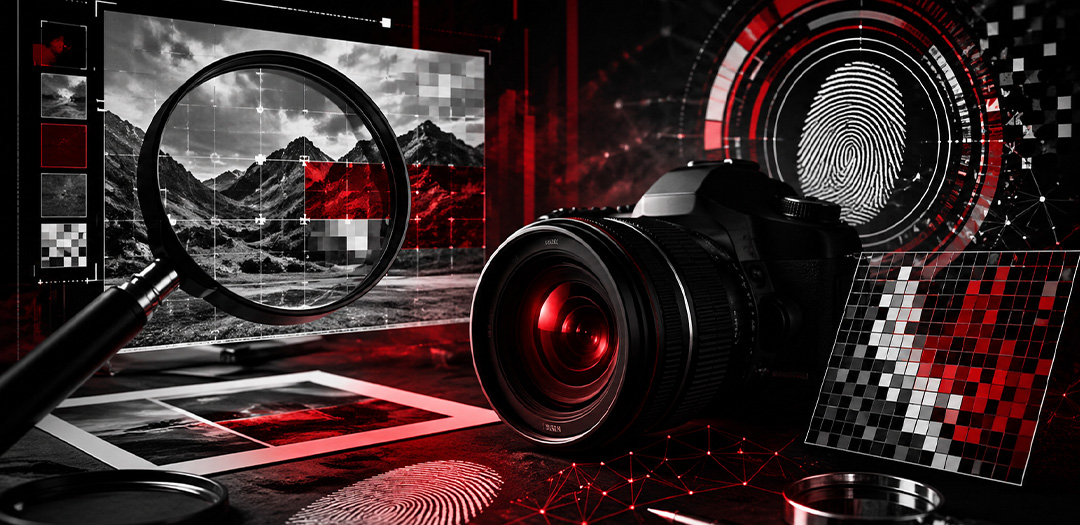
Courts across India are beginning to receive digital media as evidence in criminal and civil proceedings. Mobile footage, audio recordings, and social media videos are submitted as proof of events, statements, and identities. Without forensic authentication, there is no reliable way to tell the difference. A convincingly manipulated video will pass visual inspection by any human observer - including trained investigators. The manipulation leaves traces - but only at the pixel, acoustic, and file-structure level. Forensic media authentication is the scientific process that reads those traces and converts them into defensible evidence.
service details
Everything you receive at the conclusion of a forensic authentication engagement.

Structured court-ready PDF with executive summary, methodology, and findings - signed by the analyst.
Visual overlays for image and video files highlighting regions of detected manipulation.
Spectral forensic output for voice and audio files, documenting acoustic anomalies.
.avif)
.avif)
.avif)
.avif)
Our process
A defensible forensic finding, not a probability score.
WHO WE SERVE
Not a probability score. A defensible forensic finding.
FAQ
Hear what our clients say about our IT and security solutions
.svg)
Our methodology detects face swaps, face reenactments, GAN-generated imagery, AI-synthesized voice, audio splicing, video frame insertion or deletion, and classical image editing including cloning, compositing, and content-aware fill. It also detects re-compression manipulation and metadata tampering.
Standard turnaround is 24 to 72 hours for single-file submissions. Bulk engagements and complex multi-file cases are scoped individually. Expedited analysis is available for urgent law enforcement matters - contact our team.
Yes. Our reports are structured in alignment with the Indian Evidence Act requirements for electronic records and expert evidence. They include methodology disclosure, chain-of-custody documentation, confidence scoring, and an expert declaration - the elements required for admissibility under Sections 45A and 65B of the Evidence Act.
Yes. Compression and re-encoding affect visual quality but do not erase all forensic signals. Our file forensic layer specifically analyzes codec histories and re-compression signatures, and our visual forensic layer is calibrated for analysis of compressed media. We document the impact of compression on confidence levels where relevant.
We accept all common video formats (MP4, MOV, AVI, MKV, WebM), image formats (PNG, JPEG, WebP, TIFF, BMP), and audio formats (WAV, MP3, FLAC, M4A, OGG, WEBM). If your file is in an unusual format, contact us before submission.
get started
Tell us about your case. We respond with a forensic assessment plan within one business day.
.svg)
.svg)
.svg)
.svg)