

.png)
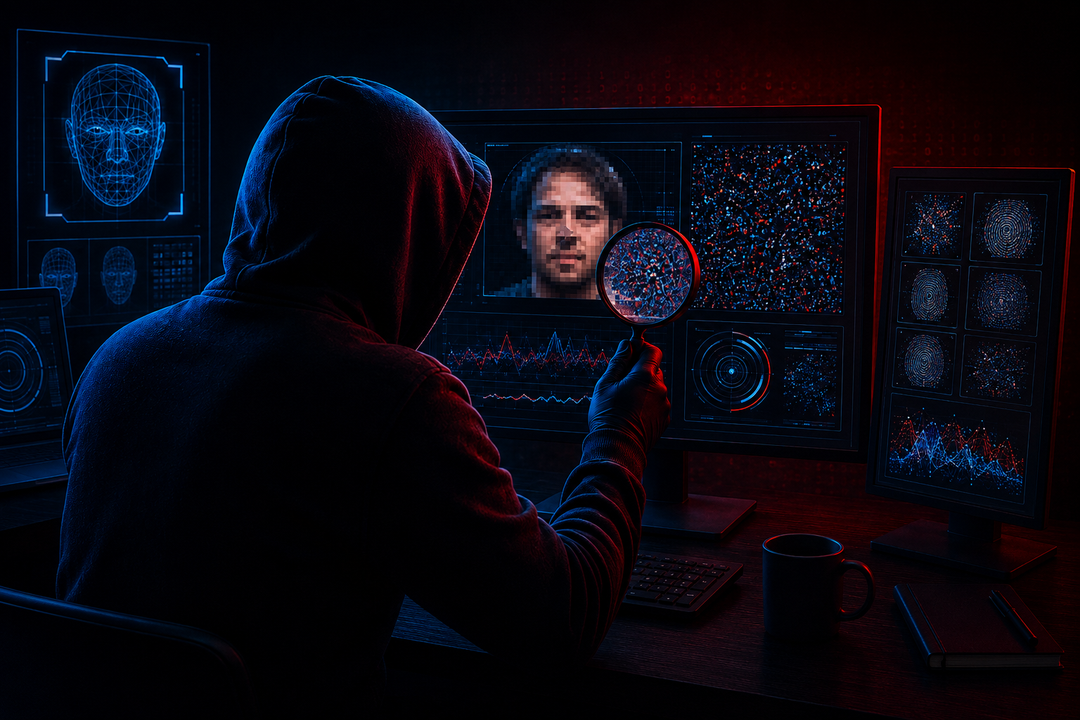
Generative adversarial networks may no longer be the dominant architecture behind the newest deepfakes, but they remain everywhere in practice. GAN-generated content still circulates widely, GAN-based face-swap tools remain accessible and heavily used, and a substantial share of the synthetic media forensics teams encounter day to day is still GAN-produced. Understanding the fingerprints these models leave behind is not outdated knowledge. It is still core forensic literacy.
This post explains what GAN fingerprints actually are, why they occur, and how forensic analysts can use them reliably in casework. It also addresses where this technique's usefulness ends, since knowing the limits of a method is as important as knowing how to apply it. This kind of foundational technique is exactly what Deepdive Forensics Lab builds into its forensic training curriculum, alongside the newer methods needed for diffusion-based content.
What Is a GAN Fingerprint?
A GAN fingerprint refers to the consistent, often imperceptible statistical patterns that a generative adversarial network leaves in the images it produces. These patterns arise from the specific architecture, training process, and upsampling operations used by the generator, and they tend to be consistent enough across images from the same model family to serve as a kind of signature.
Unlike traditional forensic artifacts from photo editing, which come from manipulating an existing image, GAN fingerprints come from the generation process itself. They are baked into every pixel of an entirely synthetic image, which makes them a fundamentally different kind of evidence to look for.
Why GANs Leave Fingerprints in the First Place
The Generator-Discriminator Training Process
A GAN consists of two networks trained in opposition. The generator produces images, and the discriminator tries to distinguish them from real ones. Over the course of training, the generator learns to fool the discriminator, but it does so within the constraints of its own architecture, which introduces consistent statistical biases into its output.
Upsampling Artifacts
Most GAN architectures generate images at low resolution and progressively upsample them to full size. This upsampling process, often involving transposed convolutions, tends to introduce regular, periodic patterns into the image, especially visible in the frequency domain even when invisible to the naked eye.
Limited Training Data Distribution
A GAN can only learn to replicate the statistical distribution of the data it was trained on. Real-world images have more diverse and complex noise characteristics than most training sets fully capture, and this gap between real-world complexity and learned distribution shows up as a detectable, if subtle, difference.
Core Techniques for Detecting GAN Fingerprints
1. Frequency Domain Analysis
Applying a Fourier transform to a suspected GAN-generated image often reveals grid-like or periodic patterns in the frequency spectrum that don't appear in natural photographs. This remains one of the most reliable and well-studied GAN detection techniques available.
2. Co-occurrence Matrix Analysis
This technique examines the statistical relationships between neighboring pixel values. Natural images and GAN-generated images tend to show measurably different co-occurrence patterns, providing another quantifiable signal independent of visual inspection.
3. Noise Residual Analysis
Extracting the noise residual from an image, essentially what's left after removing the main image content, can reveal patterns characteristic of specific GAN architectures. Camera sensor noise has well-documented statistical properties that GAN-generated noise typically fails to replicate accurately.
4. Model-Specific Fingerprint Matching
Different GAN architectures and even different training runs of the same architecture can leave distinguishable fingerprints. In some forensic contexts, this allows analysts to not just detect that an image is synthetic, but to narrow down which model or model family likely produced it, which can be valuable in attribution-focused investigations.
Where GAN Fingerprint Analysis Still Applies in 2026
Despite the rise of diffusion models, GAN fingerprint analysis remains relevant for several practical reasons.
GAN Tools Remain Widely Accessible
Many consumer-facing face-swap and image manipulation applications still rely on GAN-based architectures because they are computationally lighter and faster to run than diffusion models. This means GAN-generated content continues to appear regularly in casework.
Legacy Content Still Requires Analysis
Investigations involving older content, disputed images from past years, or ongoing legal cases involving media created before the diffusion shift, still require analysts fluent in GAN-specific detection methods.
GAN Fingerprinting Complements Newer Techniques
Even in cases where diffusion-based generation is suspected, ruling out GAN-based generation is often a useful first step in narrowing down the likely origin of a piece of media. A well-rounded analyst doesn't discard older techniques just because newer ones have emerged.
Maintaining fluency across both GAN-era and diffusion-era detection methods is part of why Deepdive Forensics Lab treats forensic training as a layered, cumulative skill set rather than a series of disconnected modules tied to whatever architecture is currently dominant.
Where GAN Fingerprint Analysis Falls Short
It Doesn't Transfer Cleanly to Diffusion Models
This is the most important limitation for a modern analyst to internalize. Diffusion models generate images through a different mathematical process, and many of the specific fingerprints associated with GAN upsampling and training dynamics simply don't apply. Relying solely on GAN fingerprint techniques against diffusion-generated content will produce unreliable results.
Post-Processing Can Obscure Fingerprints
Recompression, resizing, and platform-specific image processing can degrade or eliminate the subtle statistical signatures GAN fingerprint analysis depends on. Content that has been through multiple rounds of social media sharing often shows weaker signal than a freshly generated image.
Adversarial Awareness Is Increasing
As GAN fingerprinting has become better understood in the research community, some generation tools have started incorporating countermeasures specifically designed to reduce detectable fingerprints. This is a live arms race, not a settled body of technique.
A Practical Checklist for Applying This Technique
When assessing a suspected GAN-generated image, a thorough analyst typically works through:
- Frequency domain inspection for periodic upsampling patterns
- Noise residual extraction and comparison against expected sensor noise characteristics
- Co-occurrence matrix analysis as a secondary quantitative signal
- Cross-referencing findings against known fingerprint profiles of common GAN architectures where attribution matters
- Assessment of how much post-processing or recompression the image has likely undergone, since this affects confidence in any fingerprint-based finding
The Bottom Line
GAN fingerprint analysis is not a relic of an earlier forensic era. It remains a genuinely useful, well-validated technique for a meaningful share of the synthetic media forensic analysts encounter, particularly given how widely accessible GAN-based tools remain.
The skill worth building isn't just knowing how to run a frequency domain analysis. It's knowing when this technique applies, when it doesn't, and how to combine it with the newer methods required for diffusion-generated content. Analysts who treat detection as a single fixed toolkit, regardless of era, will always be working with gaps.
Building that layered fluency, GAN-era fundamentals alongside current diffusion-era methods, is central to the training Deepdive Forensics Lab provides forensic analysts working across the full range of synthetic media they encounter in real casework.



.svg)
.svg)
.svg)
.svg)