

.png)
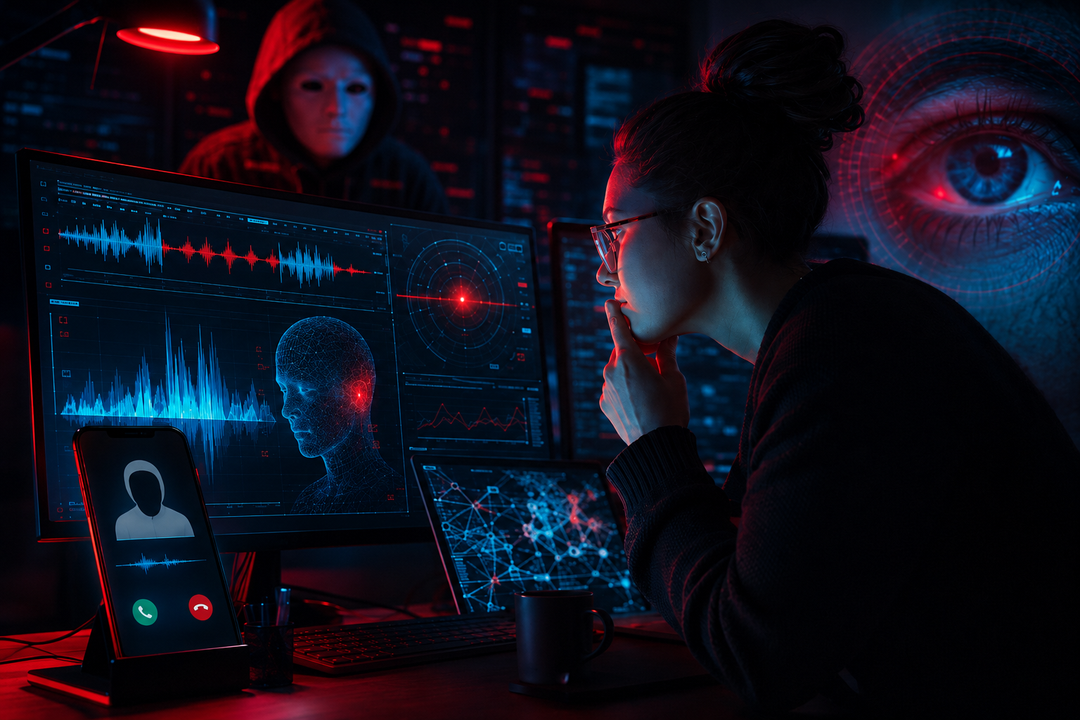
A voice on the phone used to be one of the most trusted forms of identity verification available. That assumption no longer holds. Voice cloning models can now replicate a person's speech patterns, tone, and cadence from a few seconds of audio, and attackers are using that capability to impersonate executives, family members, and officials in live phone calls. Detecting this in real time, while a call is happening, is one of the hardest problems in modern media forensics.
This post breaks down how real-time deepfake voice detection actually works, what signals investigators and security teams should be trained to catch, and where current tools fall short. It also looks at how organizations are building response protocols around this threat. This is the exact kind of work Deepdive Forensics Lab focuses on, helping teams move from theoretical awareness to operational readiness.
Why Voice Cloning Has Become a Real-Time Threat
Early voice cloning required substantial training data and processing time, which made it a poor fit for live impersonation. That has changed. Modern text-to-speech and voice conversion models can generate convincing synthetic speech from limited source audio, sometimes just seconds pulled from a public video or voicemail greeting.
Combined with low-latency inference, this means an attacker can now hold a live conversation while a model clones a target's voice in near real time, or plays back generated audio dynamically in response to a script. The result has already shown up in fraud cases involving fabricated calls from company executives authorizing wire transfers, and in scams targeting families with fake calls from a relative claiming to be in distress.
The forensics and security community has to treat this as a live-call problem, not just a recorded-media problem. That distinction changes the entire detection approach.
Why Traditional Audio Forensics Falls Short in Live Scenarios
Most established audio forensics techniques were built to analyze a recording after the fact. Spectrogram analysis, noise floor consistency checks, and codec artifact detection all assume you have time and a stored file to work with.
A live call removes both of those conditions. There is no post-processing window, and the audio is often already compressed and degraded by the calling platform itself, which can mask the subtle artifacts detectors rely on. Voice over IP compression, in particular, strips out exactly the kind of high-frequency detail that many spectral detection methods depend on.
This is the core challenge facing real-time detection: the tools that work well in a lab setting on clean audio often degrade sharply when applied to a live, compressed, lower-bandwidth phone call.
Core Techniques for Real-Time Deepfake Voice Detection
Effective real-time detection combines several layers of analysis, because no single method is reliable on its own.
1. Prosody and Micro-Rhythm Analysis
Synthetic voices often struggle to replicate natural micro-variations in rhythm, pausing, and breath patterns. Trained analysts and detection models look for unnaturally consistent pacing or breathing patterns that don't match the emotional context of the conversation.
2. Spectral Discontinuity Detection
Even compressed audio can carry faint traces of the generation process. Detection systems trained on known voice synthesis architectures look for spectral discontinuities, particularly around phoneme transitions, that differ from how a human vocal tract naturally produces sound.
3. Latency and Response Pattern Analysis
Real-time voice generation introduces processing latency that can create subtle timing irregularities in conversational turn-taking. Unusually consistent response delays, or delays that don't match the complexity of what's being said, can be a signal worth flagging.
4. Challenge-Response Verification
One of the more reliable field techniques is active rather than passive. Asking an unexpected question, one that requires genuine improvisation rather than a scripted response, can expose the limits of even sophisticated voice cloning systems, especially when paired with a live conversational AI driving the fraud.
5. Cross-Channel Verification
The strongest real-time defense usually isn't audio analysis alone. Verifying identity through a second channel, a callback to a known number, a video check, or an internal authentication code, remains one of the most effective countermeasures available today.
Organizations building detection capability around these techniques are increasingly turning to structured training, which is the kind of program Deepdive Forensics Lab has developed specifically for security and forensics teams handling live-call scenarios.
What Current Detection Tools Can and Cannot Do
There's a meaningful gap between what commercial deepfake voice detectors advertise and what they reliably deliver under real-world conditions.
Detection models trained on benchmark datasets often perform well on clean, studio-quality audio samples similar to their training data. Performance drops considerably when tested against compressed, noisy, real-world phone audio, particularly when the synthesis method is newer than what the detector was trained on.
This is not a reason to dismiss automated tools. It's a reason to use them as one layer in a broader verification process rather than a single point of trust. A detection score should inform a decision, not replace human judgment, especially in high-stakes scenarios like financial authorization or law enforcement contexts.
Teams that treat detection software as infallible are setting themselves up for failure the moment a novel synthesis method appears. This is precisely the misconception that structured forensics training exists to correct.
Building an Organizational Response Protocol
Detecting a suspicious call is only useful if there's a clear process behind it. Organizations serious about this threat typically build protocols around a few core elements.
Verification Escalation Paths
Staff need a clear, low-friction way to pause a call and verify identity through a second channel without feeling like they're accusing a legitimate caller of fraud. This has to be normalized as standard procedure, not an exceptional act.
Predefined Authentication Phrases or Codes
For high-risk functions like financial authorization, some organizations use rotating verification phrases known only to authorized personnel. This is a low-tech but effective countermeasure against even sophisticated voice cloning.
Call Recording and Post-Incident Analysis
Where legally permissible, recording high-risk calls allows forensics teams to run deeper post-call analysis using the fuller toolkit available for recorded media, even if real-time detection during the call itself was inconclusive.
Regular Simulation Exercises
Security teams that run periodic deepfake call simulations build far stronger institutional muscle memory than those relying on a one-time training session. This mirrors the adversarial thinking approach used across effective deepfake forensics education generally.
Where the Field Is Headed
Voice cloning technology will continue to improve, and the latency gap between live conversation and real-time synthesis will continue to shrink. Detection research presented at venues like ICASSP and INTERSPEECH regularly shows incremental progress on both sides of this arms race, generation and detection improving in tandem.
What's unlikely to change is the value of layered verification. No single detection technique, automated or human, is likely to remain reliably effective on its own for long. The organizations and forensics teams that build in redundancy, cross-channel verification, active challenge-response protocols, and trained human judgment, will be the ones positioned to adapt as the technology shifts.
The Bottom Line
Real-time deepfake voice detection is fundamentally harder than detecting manipulated images or recorded video, because it removes the luxury of time and often the quality of clean audio. Effective defense requires a combination of technical detection signals, active verification techniques, and organizational protocols built before an incident happens, not during one.
No detection tool available today should be treated as a standalone safeguard. The strongest protection comes from trained personnel who understand both the capabilities and the limits of current technology, backed by clear escalation procedures.
Organizations that want to build this capability, whether for financial security, executive protection, or law enforcement readiness, need more than awareness. They need structured, hands-on training grounded in real cases and current threat models. This is the work Deepdive Forensics Lab does every day, and it's where preparation for this threat should begin.



.svg)
.svg)
.svg)
.svg)