

.png)
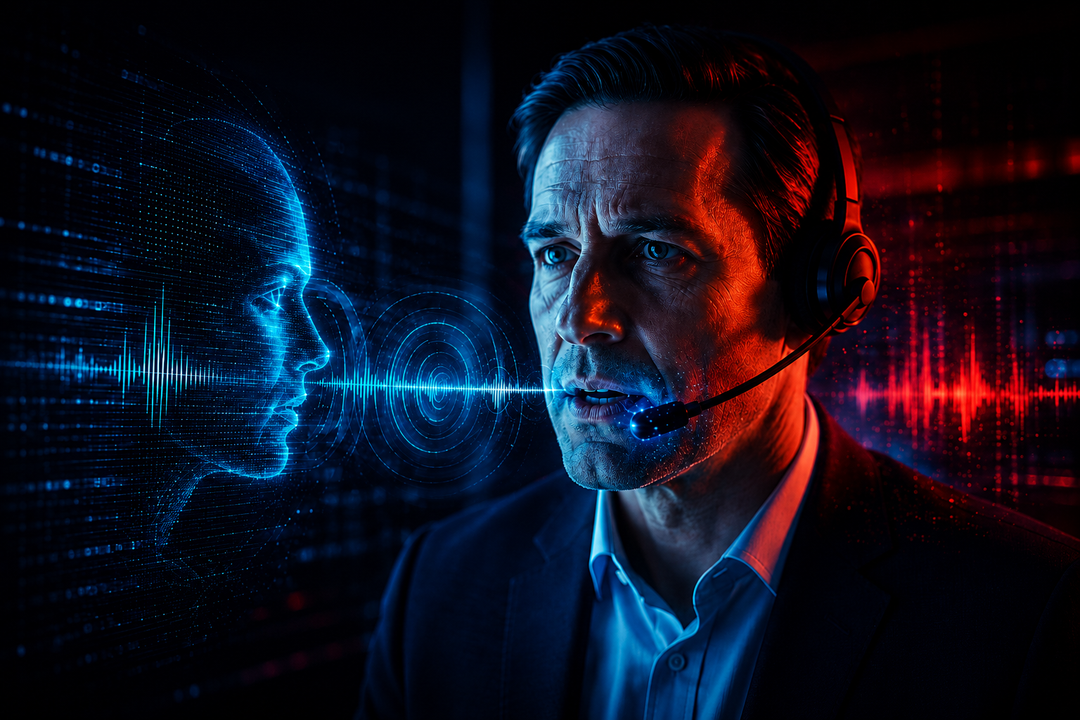
A finance employee receives a call from someone who sounds exactly like the CEO, requesting an urgent, confidential wire transfer. The voice is right. The urgency feels plausible. The instructions come through the usual channel. And the money is gone before anyone realizes the call was never the CEO at all. This is no longer a hypothetical. CEO voice cloning fraud has moved from a theoretical risk to a documented, repeatable attack pattern that finance and security teams are now being forced to build defenses against.
This post examines how this fraud pattern works, why it's proven so effective, and what companies are doing to protect themselves. It also looks at where organizational policy, not just technology, has become the primary line of defense. This is the exact threat landscape Deepdive Forensics Lab helps organizations prepare for through executive impersonation protection training.
How CEO Voice Cloning Fraud Actually Works
The mechanics are simpler than most people assume. Voice cloning models today can produce convincing synthetic speech from a small amount of source audio, often just seconds pulled from an earnings call, a conference presentation, a podcast appearance, or any other publicly available recording of an executive speaking.
Attackers use this cloned voice, sometimes combined with a live conversational AI system responding in real time, to place a call to a finance employee, executive assistant, or other staff member with transaction authority. The call typically creates urgency and confidentiality pressure, a time-sensitive acquisition, a confidential legal matter, a deadline the target doesn't want to be responsible for missing, designed specifically to discourage the kind of verification that would expose the fraud.
Because the attack exploits an existing trust relationship rather than a technical vulnerability, it bypasses most traditional cybersecurity defenses entirely. There's no malware, no phishing link, no compromised system. Just a convincing voice and a well-constructed pretext.
Why Executives Are Especially Vulnerable to This Attack
Senior executives, by the nature of their role, tend to have extensive public-facing audio available. Earnings calls, conference keynotes, media interviews, and internal town halls all provide ready source material for voice cloning, often more than enough to produce a convincing clone with widely available tools.
Executives also occupy a position where employees are culturally conditioned not to push back or slow down a request, particularly when it's framed as urgent and confidential. This combination, abundant source audio and organizational deference, makes senior leadership a disproportionately attractive target for this specific fraud pattern.
Documented Patterns in Real-World Incidents
While individual cases vary, a consistent pattern has emerged across publicly reported CEO voice cloning fraud incidents.
Financial Urgency Paired With Confidentiality
Nearly all documented cases involve a request framed as both time-sensitive and confidential, a combination specifically designed to prevent the target from consulting colleagues or following standard verification procedures.
Multi-Channel Reinforcement
More sophisticated attacks don't rely on a single phone call. They may be reinforced with a follow-up email, seemingly from the same executive, or a fabricated meeting invite, building a more convincing overall narrative than a lone phone call would achieve.
Targeting of Newer or More Junior Staff
Employees less familiar with an executive's normal communication patterns, or less empowered to question a senior leader's direct request, appear disproportionately represented among successful fraud cases.
How Companies Are Responding
Mandatory Callback Verification
The single most effective and widely adopted defense is a strict callback policy. Any request involving financial transactions above a defined threshold must be verified through a callback to a known, independently sourced phone number, never a number provided during the suspicious call itself.
Rotating Verification Codes for High-Risk Transactions
Some organizations have implemented internal verification phrases or codes, changed on a regular schedule, for any transaction request coming through voice channels. This is a low-cost, high-effectiveness countermeasure that doesn't depend on detection technology at all.
Employee Training Focused on Pressure Tactics, Not Just Technology
Effective training programs increasingly focus less on the technical details of voice cloning and more on recognizing the psychological pressure tactics, urgency, confidentiality, authority, that these attacks consistently use. Employees who can name the pattern are more likely to pause and verify regardless of how convincing the voice sounds.
Restricting Public Executive Audio Where Feasible
Some organizations have started reviewing how much unscripted, publicly available audio of senior executives exists and considering whether some public appearances could be trimmed, gated, or handled differently to reduce available source material. This is a partial mitigation at best, given how much audio already exists for most public-facing executives, but it's part of a layered approach.
Building Formal Escalation Protocols
Employees need a clear, low-friction, non-punitive way to pause a request and escalate it for verification without fear of appearing insubordinate or overly cautious. Organizations that have normalized this kind of escalation report catching more attempted fraud before money moves.
Helping organizations build this kind of layered, protocol-driven defense, rather than relying on any single safeguard, is central to the executive impersonation protection work Deepdive Forensics Lab does with corporate clients.
Where Detection Technology Fits In
Voice authentication and real-time deepfake detection tools are improving, and some organizations are beginning to deploy them on high-risk communication channels. But these tools face the same limitations documented across other real-time detection contexts: they perform well on clean audio and degrade against compressed phone calls, and they can be evaded by sufficiently sophisticated attacks.
Detection technology should be treated as a supplementary layer, not a substitute for procedural defenses like callback verification. The organizations seeing the best results are combining both, using detection tools where feasible while treating verification protocol as the primary, non-negotiable safeguard.
A Misconception Worth Correcting
There's a common assumption that this threat only matters for very large, high-profile companies with well-known executives. This isn't accurate. Voice cloning source material can come from relatively modest amounts of public audio, a single conference talk or podcast appearance is often sufficient, which means mid-sized companies and even smaller organizations with any public-facing leadership are viable targets.
The Bottom Line
CEO voice cloning fraud represents a genuinely new category of risk, one that exploits trust and urgency rather than technical vulnerabilities, and traditional cybersecurity defenses have little to offer against it directly. The organizations responding most effectively are treating this as a procedural and cultural problem as much as a technical one, building mandatory verification steps that don't depend on anyone successfully spotting a fake voice in the moment.
No single safeguard is sufficient on its own. Callback verification, rotating codes, employee training focused on pressure tactics, and supplementary detection technology all need to work together as layered defense.
Helping organizations build and stress-test that layered defense before an incident happens, not after, is the work Deepdive Forensics Lab does through its executive impersonation protection services.




.svg)
.svg)
.svg)
.svg)